Back to Blog
Why Your Brand Is Invisible in AI Search (And How to Fix It)
StableWorks
Data-backed research on Answer Engine Optimization reveals how AI search reshapes brand visibility and the steps companies can take to remain the default recommendation.
Oct 3, 2025
Back to Blog
Why Your Brand Is Invisible in AI Search (And How to Fix It)
StableWorks
Data-backed research on Answer Engine Optimization reveals how AI search reshapes brand visibility and the steps companies can take to remain the default recommendation.
Oct 3, 2025
Back to Blog
Why Your Brand Is Invisible in AI Search (And How to Fix It)
StableWorks
Data-backed research on Answer Engine Optimization reveals how AI search reshapes brand visibility and the steps companies can take to remain the default recommendation.
Oct 3, 2025

The search revolution is here. While you're optimizing for Google's page one, your competitors are already being recommended by ChatGPT.If you've noticed a mysterious dip in your organic traffic lately, you're not imagining it. The digital landscape has undergone a seismic shift, and many brands are waking up to find themselves completely invisible in the new world of AI-powered search.Traditional SEO alone won't save you anymore.
The Traffic Crisis No One Saw Coming
Between May 2024 and May 2025, zero-click searches surged from 56% to 69%. Nearly seven out of ten searches now end without anyone clicking on a website link. Educational platform Chegg reported a devastating 49% decline in non-subscriber traffic as AI Overviews began answering the homework questions that previously drove students to their site.DMG Media, which owns MailOnline and Metro, reported click-through rate declines of nearly 90% for certain searches. HubSpot saw traffic plummet by 75% in 2024 alone, a company that essentially built its empire on SEO.But not every brand is suffering. While some companies watch their traffic evaporate, others are capturing unprecedented mindshare in AI-powered conversations. The difference? They've mastered Answer Engine Optimization (AEO).
Welcome to the Answer Engine Era
Search engines are dead. Long live answer engines.Today's users want immediate, synthesized answers rather than ten blue links. ChatGPT commands an estimated 80%+ market share of AI model usage among consumers, while Google rolls out AI Overviews to 18% of searches and growing. The shift is undeniable.The AI search market itself is exploding, projected to reach $108.88 billion by 2032, growing at a 14% compound annual rate. More telling: 61% of U.S. adults used AI to search for information in the past six months, and 34% have used ChatGPT specifically, roughly double the usage from 2023.This represents a fundamental rewiring of how people discover information, evaluate brands, and make purchase decisions.
The Brutal Reality: High Rankings Mean Nothing
High Google rankings do not guarantee top placement in ChatGPT or Google AI Mode.What matters now is completely different. Structured data, accessible pricing information, and third-party validation from industry publications carry far more weight than your position in organic search results. When AI Overviews appear, the click-through rate for the #1 organic position drops by a staggering 34.5% on average.Even more shocking: websites using schema markup saw 58% higher visibility in AI snippets compared to those without it. The game has changed, and the old playbook is obsolete.
The Great Divide: Mentions vs. Sources
One of the most fascinating dynamics in AI search is what we call the "mention-source divide," and it perfectly illustrates why brands need to rethink their entire approach.Consider the Zapier paradox: Zapier ranks as the #1 cited source but only #44 in brand mentions. The company's hundreds of integration tutorials make it an authoritative source for AI models, yet consumers discuss other brands more frequently in conversations and reviews.This reveals a critical insight: mentions and sources serve different strategic purposes.Sources tend to be minimized visually in AI responses and are scarcely clicked, functioning as footnotes. But if your brand is mentioned directly in the answer itself, you increase awareness and dominate the conversation. That's the real prize.
Industry-Specific Realities
AI search doesn't treat every industry the same. The rules shift dramatically depending on what users care about, how competitive the market is, and where AI models find their data.
What ChatGPT Actually Reads
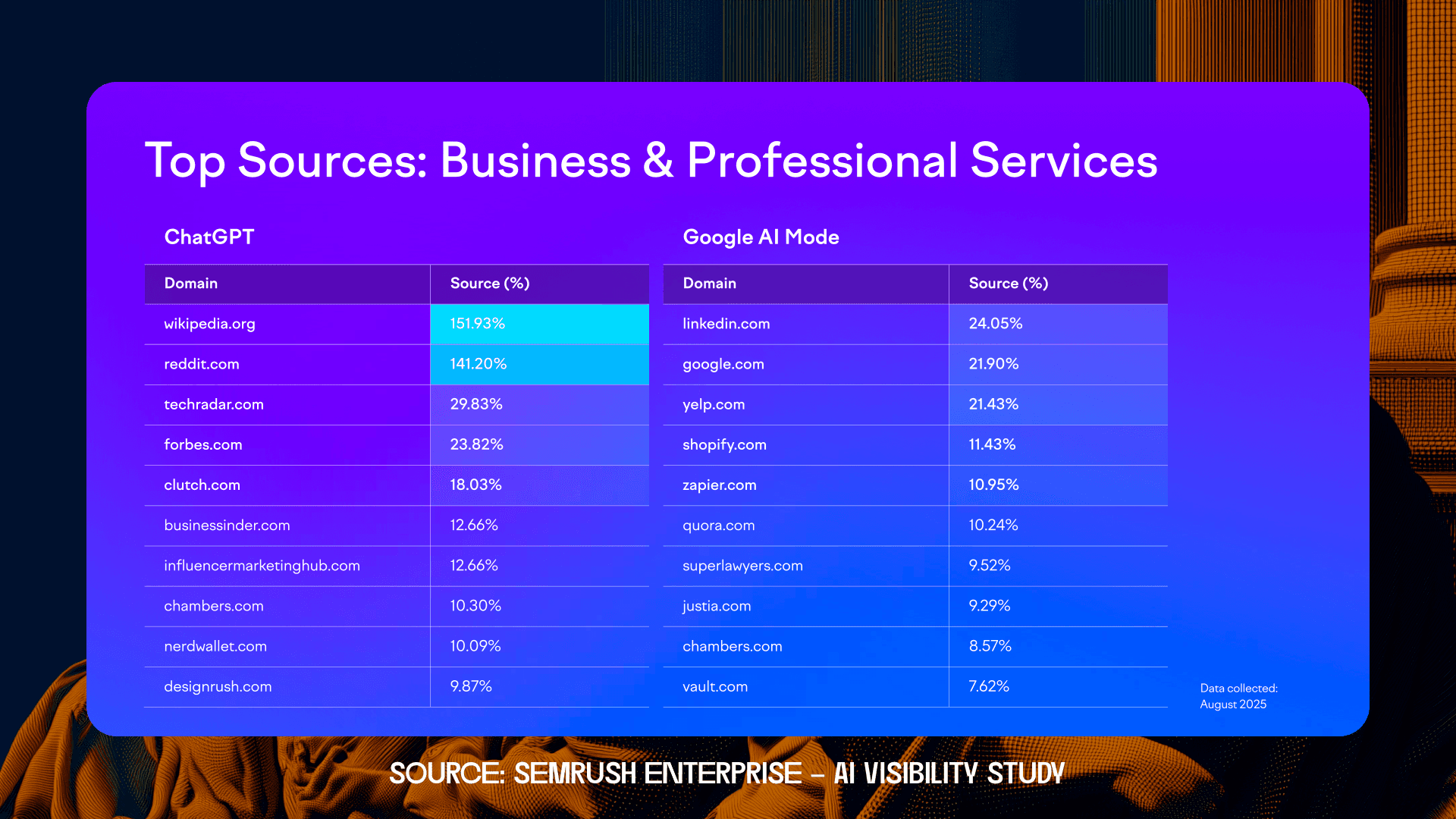
Reddit and Wikipedia completely dominate ChatGPT's training data, with each referenced more than once per prompt on average: 141.20% for Reddit and 151.93% for Wikipedia. Industry-specific sources like TechRadar (29.83%), Forbes (23.82%), and Clutch.co (18.03%) also feature prominently.This is why user-generated content and community discussions have become the new currency of visibility.
Google AI Mode's Preferences
LinkedIn leads Google AI Mode citations at 24.05%, followed by Google's own properties (21.90%) and Yelp (21.43%). This reflects Google's deep reliance on its Knowledge Graph, business listings, and professional networks.The takeaway? Your Google Business Profile, LinkedIn presence, and review management are essential components of your AI visibility strategy.
The Brand Effect: Why Recognition Trumps Everything
Iconic brands consistently top AI rankings through strategic targeting of their niches, even in industries where competitors might be more well-known or previously dominated organic visibility.In our analysis of AI visibility, a handful of familiar leaders dominate the conversation:
Microsoft dominates at a 52.86% mention rateGoogle follows at 41.25%Amazon takes third with 25.40%Security leaders like Palo Alto Networks (12.37%) and CrowdStrike (8.76%) punch well above their marketing budgets through strong technical authority
But here's the surprise: Zoho at 17.28% punches well above its market cap, driven by comprehensive platform offerings and an active Reddit community. This proves that you don't need to be the biggest to be the most helpful where AI engines are paying attention.
Understanding Your Industry's AI Landscape
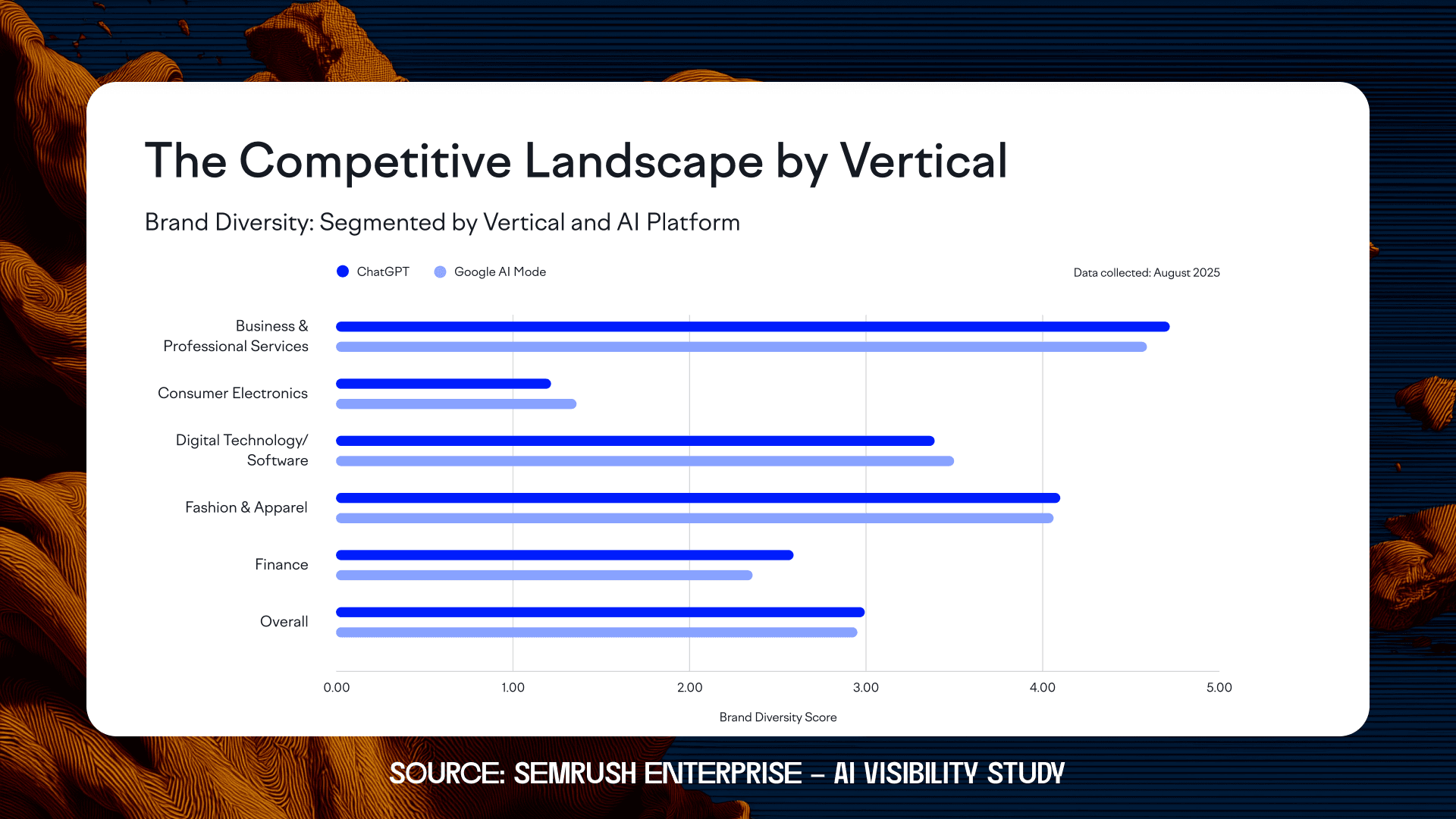
The competitive dynamics in AI search vary dramatically by industry. Our analysis reveals five distinct competitive categories that determine how difficult it will be for your brand to gain visibility:
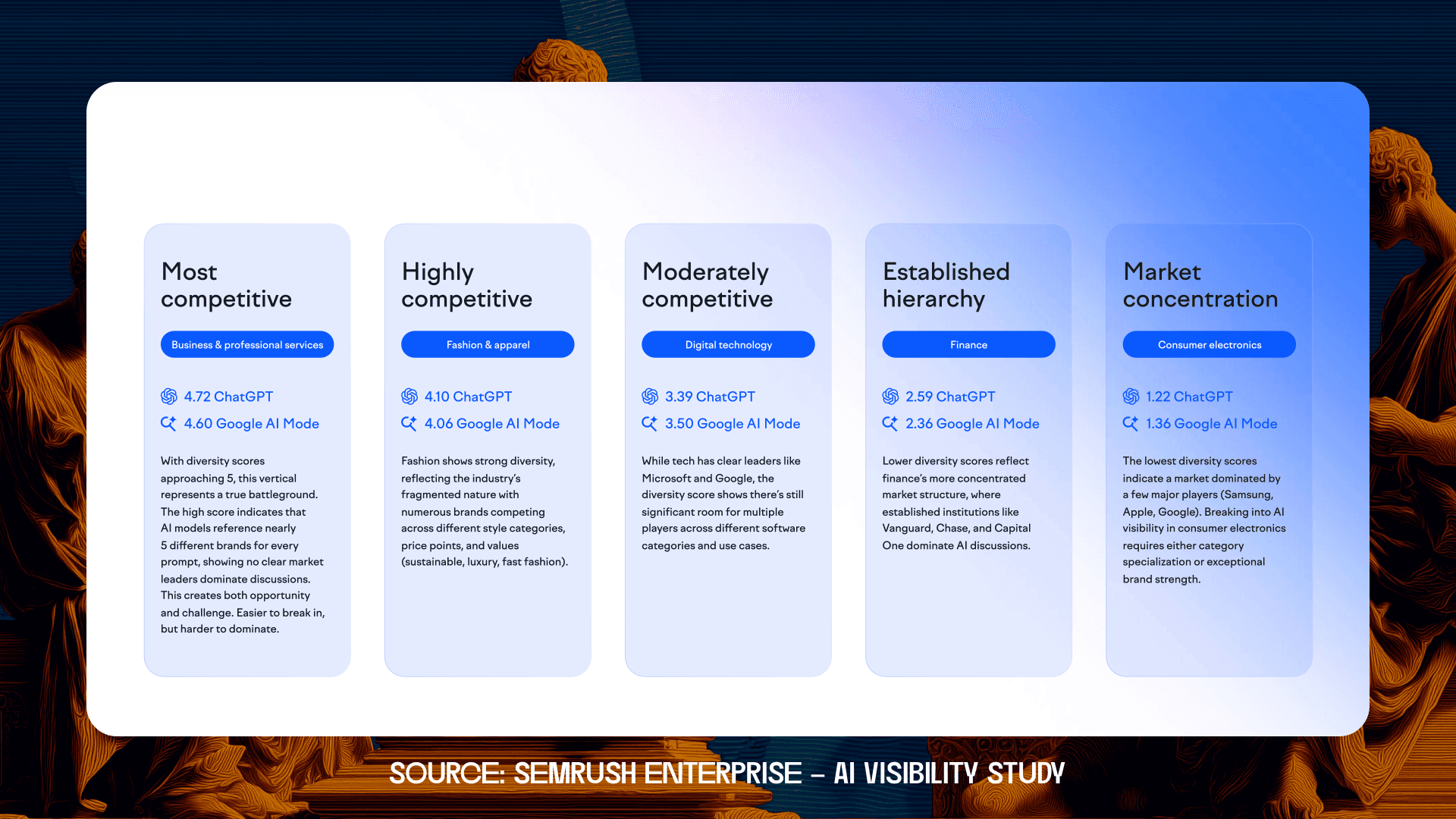
Most Competitive: Business & Professional Services (4.72 ChatGPT / 4.60 Google AI Mode) — With diversity scores approaching five, this sector represents a true battleground. The high score indicates that AI references nearly five different brands for every prompt, showing no clear market leaders in AI discussions. This creates both opportunity and challenge: easier to break in, but harder to dominate.
Highly Competitive: Fashion & Apparel (4.10 ChatGPT / 4.06 Google AI Mode) — Fashion shows strong diversity, reflecting the industry's fragmented nature with numerous brands competing across different style categories, price points, and values (sustainable, luxury, fast fashion).
Moderately Competitive: Digital Technology (3.39 ChatGPT / 3.50 Google AI Mode) — While tech has clear leaders like Microsoft and Google, the diversity score shows there's still significant room for multiple players across different software categories and use cases.
Established Hierarchy: Finance (2.59 ChatGPT / 2.36 Google AI Mode) — Lower diversity scores reflect finance's more concentrated market structure, where established institutions like Vanguard, Chase, and Capital One dominate AI discussions.
Market Concentration: Consumer Electronics (1.22 ChatGPT / 1.36 Google AI Mode) — The lowest diversity scores indicate a market dominated by a few major players (Samsung, Apple, Google). Breaking into AI visibility in consumer electronics requires either category specialization or exceptional brand strength.
The User-Generated Content Revolution
AI models rely heavily on forums, reviews, and social posts to shape brand rankings. These user-driven sources now outweigh much of traditional SEO.
Samsung leads smartphone mentions at 58.08%, with Apple close behind at 48.84%, but much of this dominance comes from their extensive presence in support forums and community discussions, not just from their corporate websites.
The Apple Support Page Strategy reveals a crucial insight: Google AI Mode frequently cites Apple.com URLs that are actually support pages and forums where users share feature information and get tech support. This demonstrates that branded support content containing user-generated discussions serves as authoritative sources for AI engines.
Encouraging authentic reviews becomes critical
Building and monitoring community forums pays dividends
Reddit presence is no longer optional
User testimonials need to be structured and accessible
The Technical Reality: Excellence Is the New Baseline
Make no mistake: technically excellent websites are an absolute must in the AI era.
Work with technical teams to ensure that:
Key content is properly indexed
Information is well-structured
Content is available within static HTML (AI crawlers struggle with dynamic content)
Schema markup is implemented across all critical pages
Site speed and Core Web Vitals meet modern standards
A DemandSage report found that websites implementing schema markup were 2.4 times more likely to appear in AI-generated results. For startups and smaller brands, this low-cost adjustment offers outsized returns.
The Cost of Delay
Every day you wait, your competitors establish more authoritative positions in AI training data and real-time search results.
By 2026, Gartner predicts that 25% of organic traffic will move to AI chatbots and virtual agents. Companies that delay AEO implementation face increasingly expensive catch-up requirements as competitors cement their positions.
NerdWallet provides the counterexample: despite seeing a 20% decrease in site traffic, they reported 35% growth in revenue by ensuring their content and brand expertise reached consumers through AI summaries and other channels. They proved that while traffic patterns shift, strategic visibility drives business results.
What Winners Are Doing Differently
The brands thriving in this new landscape share common characteristics:
They Answer Questions, Not Keywords — Rather than optimizing for search terms, they structure content around the actual questions their customers ask. They publish FAQ pages, how-to guides, and comparison tables formatted for AI consumption.
They Build Authority Everywhere — They don't just focus on their own website. They actively participate in Reddit discussions, manage Yelp reviews, maintain robust LinkedIn profiles, and earn mentions in industry publications.
They Embrace Structured Data — Schema markup has become essential. They implement FAQ schema, HowTo schema, Product schema, Review schema, and Local Business schema consistently across their properties.
They Create Citation-Worthy Content — Their content includes quantifiable results, specific case studies, data tables, and authoritative sources that AI engines can confidently cite.
They Monitor the New Metrics — Beyond traffic and rankings, they track:
AI citation rates across ChatGPT, Perplexity, and Google AI
Brand mention frequency in AI responses
Share of voice compared to competitors
Zero-click impression rates
The Bottom Line
The search revolution has arrived. While organic traffic from traditional search may be declining, overall search volume is actually up 22% year-over-year, with over 14 billion Google searches processed daily.
The opportunity hasn't disappeared. It's simply moved.
Brands that adapt their strategies to this new reality will capture disproportionate mindshare by creating structured, authoritative content that AI engines can easily understand and cite. Those that cling to traditional SEO alone will find themselves increasingly invisible to the very audiences they're trying to reach.
The choice is yours: evolve with the search landscape, or watch your competitors become the default answer while you fade into irrelevance.
The good news? You don't need to throw out everything you've built. Answer Engine Optimization builds on SEO fundamentals as an evolution, not a replacement. But it requires new thinking, new tactics, and most importantly, action.
In the age of AI search, being the best answer no longer suffices. You have to be the answer that AI engines choose to share.
Ready to Make Your Brand Visible in AI Search?
The brands winning in 2025 aren't leaving their AI visibility to chance. They're implementing comprehensive Answer Engine Optimization strategies that ensure they're found, cited, and recommended when it matters most.
At Stableworks, we help brands navigate this new landscape with data-driven AEO strategies that deliver measurable results. Let's discuss how to make your brand the answer AI engines recommend.
Contact us to start your Answer Engine Optimization strategy today.
The search revolution is here. While you're optimizing for Google's page one, your competitors are already being recommended by ChatGPT.If you've noticed a mysterious dip in your organic traffic lately, you're not imagining it. The digital landscape has undergone a seismic shift, and many brands are waking up to find themselves completely invisible in the new world of AI-powered search.Traditional SEO alone won't save you anymore.
The Traffic Crisis No One Saw Coming
Between May 2024 and May 2025, zero-click searches surged from 56% to 69%. Nearly seven out of ten searches now end without anyone clicking on a website link. Educational platform Chegg reported a devastating 49% decline in non-subscriber traffic as AI Overviews began answering the homework questions that previously drove students to their site.DMG Media, which owns MailOnline and Metro, reported click-through rate declines of nearly 90% for certain searches. HubSpot saw traffic plummet by 75% in 2024 alone, a company that essentially built its empire on SEO.But not every brand is suffering. While some companies watch their traffic evaporate, others are capturing unprecedented mindshare in AI-powered conversations. The difference? They've mastered Answer Engine Optimization (AEO).
Welcome to the Answer Engine Era
Search engines are dead. Long live answer engines.Today's users want immediate, synthesized answers rather than ten blue links. ChatGPT commands an estimated 80%+ market share of AI model usage among consumers, while Google rolls out AI Overviews to 18% of searches and growing. The shift is undeniable.The AI search market itself is exploding, projected to reach $108.88 billion by 2032, growing at a 14% compound annual rate. More telling: 61% of U.S. adults used AI to search for information in the past six months, and 34% have used ChatGPT specifically, roughly double the usage from 2023.This represents a fundamental rewiring of how people discover information, evaluate brands, and make purchase decisions.
The Brutal Reality: High Rankings Mean Nothing
High Google rankings do not guarantee top placement in ChatGPT or Google AI Mode.What matters now is completely different. Structured data, accessible pricing information, and third-party validation from industry publications carry far more weight than your position in organic search results. When AI Overviews appear, the click-through rate for the #1 organic position drops by a staggering 34.5% on average.Even more shocking: websites using schema markup saw 58% higher visibility in AI snippets compared to those without it. The game has changed, and the old playbook is obsolete.
The Great Divide: Mentions vs. Sources
One of the most fascinating dynamics in AI search is what we call the "mention-source divide," and it perfectly illustrates why brands need to rethink their entire approach.Consider the Zapier paradox: Zapier ranks as the #1 cited source but only #44 in brand mentions. The company's hundreds of integration tutorials make it an authoritative source for AI models, yet consumers discuss other brands more frequently in conversations and reviews.This reveals a critical insight: mentions and sources serve different strategic purposes.Sources tend to be minimized visually in AI responses and are scarcely clicked, functioning as footnotes. But if your brand is mentioned directly in the answer itself, you increase awareness and dominate the conversation. That's the real prize.
Industry-Specific Realities
AI search doesn't treat every industry the same. The rules shift dramatically depending on what users care about, how competitive the market is, and where AI models find their data.
What ChatGPT Actually Reads
Reddit and Wikipedia completely dominate ChatGPT's training data, with each referenced more than once per prompt on average: 141.20% for Reddit and 151.93% for Wikipedia. Industry-specific sources like TechRadar (29.83%), Forbes (23.82%), and Clutch.co (18.03%) also feature prominently.This is why user-generated content and community discussions have become the new currency of visibility.
Google AI Mode's Preferences
LinkedIn leads Google AI Mode citations at 24.05%, followed by Google's own properties (21.90%) and Yelp (21.43%). This reflects Google's deep reliance on its Knowledge Graph, business listings, and professional networks.The takeaway? Your Google Business Profile, LinkedIn presence, and review management are essential components of your AI visibility strategy.
The Brand Effect: Why Recognition Trumps Everything
Iconic brands consistently top AI rankings through strategic targeting of their niches, even in industries where competitors might be more well-known or previously dominated organic visibility.In our analysis of AI visibility, a handful of familiar leaders dominate the conversation:
Microsoft dominates at a 52.86% mention rateGoogle follows at 41.25%Amazon takes third with 25.40%Security leaders like Palo Alto Networks (12.37%) and CrowdStrike (8.76%) punch well above their marketing budgets through strong technical authority
But here's the surprise: Zoho at 17.28% punches well above its market cap, driven by comprehensive platform offerings and an active Reddit community. This proves that you don't need to be the biggest to be the most helpful where AI engines are paying attention.
Understanding Your Industry's AI Landscape
The competitive dynamics in AI search vary dramatically by industry. Our analysis reveals five distinct competitive categories that determine how difficult it will be for your brand to gain visibility:
Most Competitive: Business & Professional Services (4.72 ChatGPT / 4.60 Google AI Mode) — With diversity scores approaching five, this sector represents a true battleground. The high score indicates that AI references nearly five different brands for every prompt, showing no clear market leaders in AI discussions. This creates both opportunity and challenge: easier to break in, but harder to dominate.
Highly Competitive: Fashion & Apparel (4.10 ChatGPT / 4.06 Google AI Mode) — Fashion shows strong diversity, reflecting the industry's fragmented nature with numerous brands competing across different style categories, price points, and values (sustainable, luxury, fast fashion).
Moderately Competitive: Digital Technology (3.39 ChatGPT / 3.50 Google AI Mode) — While tech has clear leaders like Microsoft and Google, the diversity score shows there's still significant room for multiple players across different software categories and use cases.
Established Hierarchy: Finance (2.59 ChatGPT / 2.36 Google AI Mode) — Lower diversity scores reflect finance's more concentrated market structure, where established institutions like Vanguard, Chase, and Capital One dominate AI discussions.
Market Concentration: Consumer Electronics (1.22 ChatGPT / 1.36 Google AI Mode) — The lowest diversity scores indicate a market dominated by a few major players (Samsung, Apple, Google). Breaking into AI visibility in consumer electronics requires either category specialization or exceptional brand strength.
The User-Generated Content Revolution
AI models rely heavily on forums, reviews, and social posts to shape brand rankings. These user-driven sources now outweigh much of traditional SEO.
Samsung leads smartphone mentions at 58.08%, with Apple close behind at 48.84%, but much of this dominance comes from their extensive presence in support forums and community discussions, not just from their corporate websites.
The Apple Support Page Strategy reveals a crucial insight: Google AI Mode frequently cites Apple.com URLs that are actually support pages and forums where users share feature information and get tech support. This demonstrates that branded support content containing user-generated discussions serves as authoritative sources for AI engines.
Encouraging authentic reviews becomes critical
Building and monitoring community forums pays dividends
Reddit presence is no longer optional
User testimonials need to be structured and accessible
The Technical Reality: Excellence Is the New Baseline
Make no mistake: technically excellent websites are an absolute must in the AI era.
Work with technical teams to ensure that:
Key content is properly indexed
Information is well-structured
Content is available within static HTML (AI crawlers struggle with dynamic content)
Schema markup is implemented across all critical pages
Site speed and Core Web Vitals meet modern standards
A DemandSage report found that websites implementing schema markup were 2.4 times more likely to appear in AI-generated results. For startups and smaller brands, this low-cost adjustment offers outsized returns.
The Cost of Delay
Every day you wait, your competitors establish more authoritative positions in AI training data and real-time search results.
By 2026, Gartner predicts that 25% of organic traffic will move to AI chatbots and virtual agents. Companies that delay AEO implementation face increasingly expensive catch-up requirements as competitors cement their positions.
NerdWallet provides the counterexample: despite seeing a 20% decrease in site traffic, they reported 35% growth in revenue by ensuring their content and brand expertise reached consumers through AI summaries and other channels. They proved that while traffic patterns shift, strategic visibility drives business results.
What Winners Are Doing Differently
The brands thriving in this new landscape share common characteristics:
They Answer Questions, Not Keywords — Rather than optimizing for search terms, they structure content around the actual questions their customers ask. They publish FAQ pages, how-to guides, and comparison tables formatted for AI consumption.
They Build Authority Everywhere — They don't just focus on their own website. They actively participate in Reddit discussions, manage Yelp reviews, maintain robust LinkedIn profiles, and earn mentions in industry publications.
They Embrace Structured Data — Schema markup has become essential. They implement FAQ schema, HowTo schema, Product schema, Review schema, and Local Business schema consistently across their properties.
They Create Citation-Worthy Content — Their content includes quantifiable results, specific case studies, data tables, and authoritative sources that AI engines can confidently cite.
They Monitor the New Metrics — Beyond traffic and rankings, they track:
AI citation rates across ChatGPT, Perplexity, and Google AI
Brand mention frequency in AI responses
Share of voice compared to competitors
Zero-click impression rates
The Bottom Line
The search revolution has arrived. While organic traffic from traditional search may be declining, overall search volume is actually up 22% year-over-year, with over 14 billion Google searches processed daily.
The opportunity hasn't disappeared. It's simply moved.
Brands that adapt their strategies to this new reality will capture disproportionate mindshare by creating structured, authoritative content that AI engines can easily understand and cite. Those that cling to traditional SEO alone will find themselves increasingly invisible to the very audiences they're trying to reach.
The choice is yours: evolve with the search landscape, or watch your competitors become the default answer while you fade into irrelevance.
The good news? You don't need to throw out everything you've built. Answer Engine Optimization builds on SEO fundamentals as an evolution, not a replacement. But it requires new thinking, new tactics, and most importantly, action.
In the age of AI search, being the best answer no longer suffices. You have to be the answer that AI engines choose to share.
Ready to Make Your Brand Visible in AI Search?
The brands winning in 2025 aren't leaving their AI visibility to chance. They're implementing comprehensive Answer Engine Optimization strategies that ensure they're found, cited, and recommended when it matters most.
At Stableworks, we help brands navigate this new landscape with data-driven AEO strategies that deliver measurable results. Let's discuss how to make your brand the answer AI engines recommend.
Contact us to start your Answer Engine Optimization strategy today.
More Articles
Written by
Aaron W.
Nov 24, 2025
The Context Window Expansion and What It Means for Your Business
Context windows expanded 1,000x in five years, enabling AI to process entire contracts, codebases, and document libraries in one pass. Practical guide to capabilities, limitations, costs, and when to use long context versus RAG.

Written by
Aaron W.
Nov 24, 2025
The Context Window Expansion and What It Means for Your Business
Context windows expanded 1,000x in five years, enabling AI to process entire contracts, codebases, and document libraries in one pass. Practical guide to capabilities, limitations, costs, and when to use long context versus RAG.
Written by
Aaron W.
Nov 24, 2025
The Context Window Expansion and What It Means for Your Business
Context windows expanded 1,000x in five years, enabling AI to process entire contracts, codebases, and document libraries in one pass. Practical guide to capabilities, limitations, costs, and when to use long context versus RAG.
Written by
Aaron W.
Oct 24, 2025
The Real Business Impact of AI According to 2024-2025 Data
Research from 2024-2025 reveals that strategic AI implementation delivers 3-10x ROI while 95% of companies see zero returns, with success determined by investment levels, data infrastructure maturity, and treating AI as business transformation rather than technology adoption.

Written by
Aaron W.
Oct 24, 2025
The Real Business Impact of AI According to 2024-2025 Data
Research from 2024-2025 reveals that strategic AI implementation delivers 3-10x ROI while 95% of companies see zero returns, with success determined by investment levels, data infrastructure maturity, and treating AI as business transformation rather than technology adoption.
Written by
Aaron W.
Oct 24, 2025
The Real Business Impact of AI According to 2024-2025 Data
Research from 2024-2025 reveals that strategic AI implementation delivers 3-10x ROI while 95% of companies see zero returns, with success determined by investment levels, data infrastructure maturity, and treating AI as business transformation rather than technology adoption.
Written by
Aaron W
Oct 17, 2025
When Uncertainty Becomes the Safety Signal: How AI Companies Are Deploying Precautionary Safeguards
Anthropic, OpenAI, and Google deployed their newest models with enhanced safety protections before proving they were necessary, implementing precautionary safeguards when evaluation uncertainty itself became the risk signal.

Written by
Aaron W
Oct 17, 2025
When Uncertainty Becomes the Safety Signal: How AI Companies Are Deploying Precautionary Safeguards
Anthropic, OpenAI, and Google deployed their newest models with enhanced safety protections before proving they were necessary, implementing precautionary safeguards when evaluation uncertainty itself became the risk signal.
Written by
Aaron W
Oct 17, 2025
When Uncertainty Becomes the Safety Signal: How AI Companies Are Deploying Precautionary Safeguards
Anthropic, OpenAI, and Google deployed their newest models with enhanced safety protections before proving they were necessary, implementing precautionary safeguards when evaluation uncertainty itself became the risk signal.